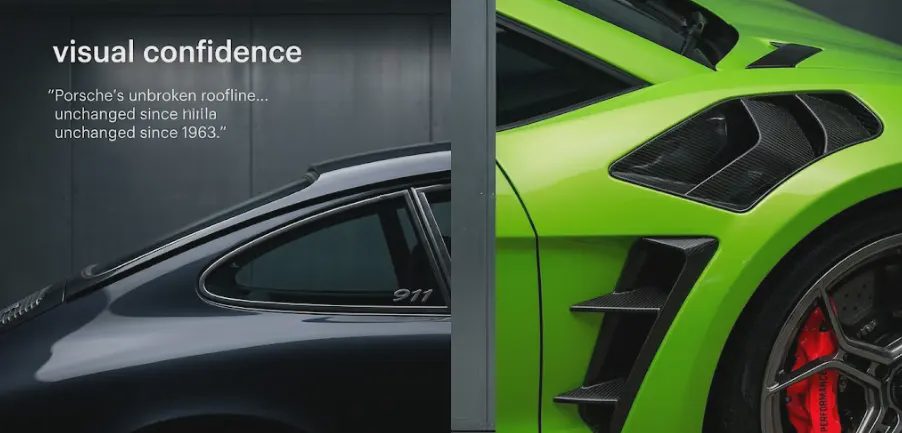
There is a specific kind of confidence that makes no demands on your attention. It does not interrupt. It does not chase you with louder graphics or angrier sheet metal. It simply occupies its space, certain that if you have the eye for it, you will understand. In the automotive world, no marque embodies this more completely than Porsche. While other luxury brands churn through design languages, performance claims, and identity crises, Porsche remains improbably steady. It rarely needs to explain itself, because its authority has been built, line by line, over seven decades.
This is not a statement about engineering, although the engineering is exceptional. It is a statement about brand psychology. Porsche’s most potent luxury signal is not its horsepower or its Nürburgring time. It is the accumulated visual confidence that comes from refusing to perform.
The Authority of Consistency
Brand authority is not built in press releases. It is accumulated through the repeated, disciplined delivery of a coherent visual promise. In my work on automotive brand positioning, I have observed a clear pattern: the brands that project genuine, lasting prestige are the ones that protect their design DNA with near-religious conviction. Porsche is the textbook case.
Question: What separates brands that project quiet authority from those that rely on performance theater?
Authority (Self-Possession) | Performance Theater (Loudness) |
|---|---|
Design evolution so gradual it reads as refinement, not reinvention | Design revolutions that break continuity to appear “modern” |
Silhouette remains the hero — recognizable across decades | Silhouette changes dramatically, sacrificing memory for novelty |
Restrained surfacing, badging, and cabin language | Aggressive vents, oversized grilles, and shouting exhausts |
Heritage as a foundation, not a marketing tagline | Heritage borrowed or exaggerated to create a story the product cannot sustain |
The car does not demand that you notice it | The car insists you look at it, repeatedly |
Porsche’s silhouette is the most eloquent example of authority through consistency. The 911’s roofline — that unbroken arc from the top of the windshield to the trailing edge of the rear deck — has remained largely intact since 1963. It has been adjusted by millimeters, never by ideology. A child who recognizes a 1964 911 will also recognize a 2024 911. That is not a failure of imagination. That is a design culture with the discipline to know what is sacred and the wisdom not to touch it.
Most brands panic when a design language ages. They hire new chief designers, commission dramatic redesigns, and flood the market with images of “a new era.” Porsche, by contrast, treats its visual identity as a living heritage site. Changes happen, but they happen slowly, under the surface, in the surfacing tension of a rear fender or the LED reinterpretation of a round headlight. The result is a car that feels contemporary without ever feeling unmoored from its own history.
The Language of Visual Self-Possession
Self-possession is a difficult quality to design because it requires subtraction, not addition. It asks designers to resist the temptation to over-gesture. A Porsche does not need four exhaust outlets per side, a grille the size of a radiator screen, or twenty-eight LED elements forming a squinting eyebrow. Its presence comes from proportion, stance, and the quiet tension of its surfaces.
Consider the Porsche interior. Walk into a 911 cabin and you are met not with theatricality but with clarity. The instrument cluster is anchored by the central tachometer — a direct nod to the car’s motorsport origins, but executed without drama. Screens are integrated into the horizontal architecture rather than bolted on as afterthoughts. The material quality is high, but it is a quiet kind of richness — leather that smells like a workshop, not a perfume counter; aluminum trim that is cool and precise, not glittering.
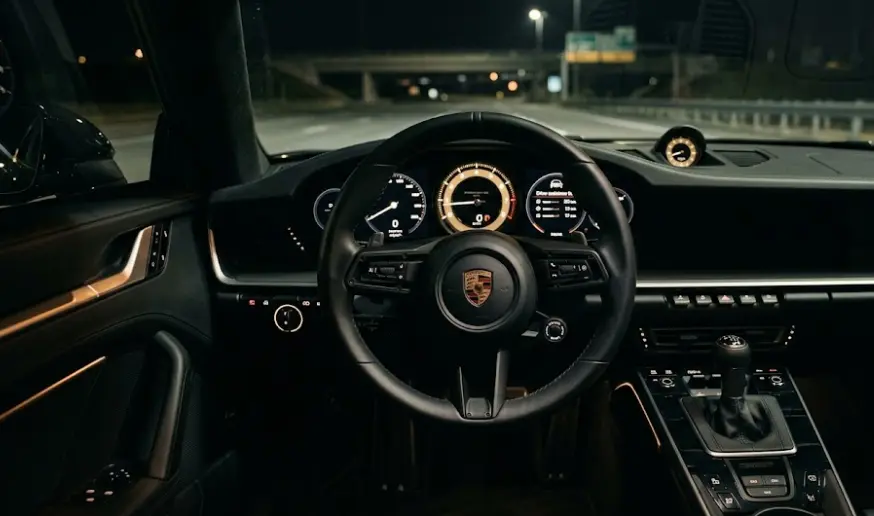
This is what I call emotional precision. The interior does not overstimulate. It does not present you with a cascading light show or a curved screen that dominates the architecture. It asks you to settle in, find your line of sight, and focus. The experience is designed around the driver’s concentration, not the passenger’s entertainment. That restraint is a luxury signal far more sophisticated than any volume of ambient lighting.
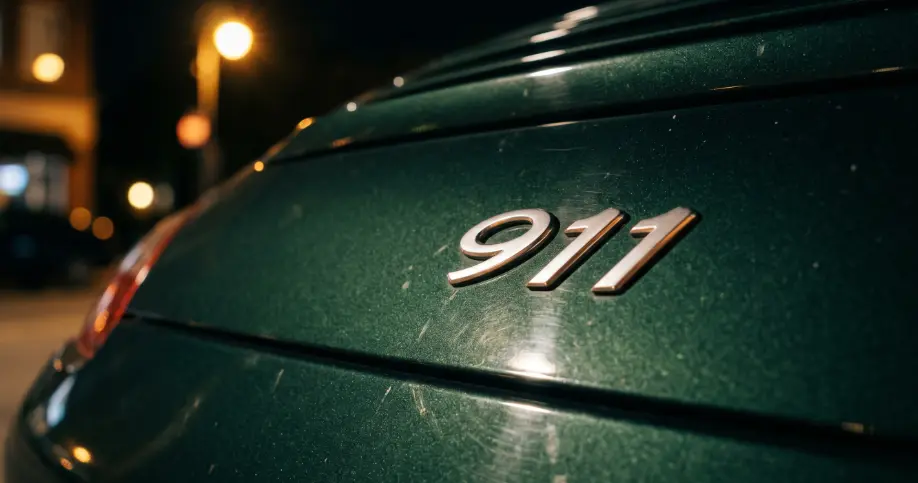
Porsche’s exterior badging follows the same logic. The script on the rear deck is small, chrome, and placed exactly where it needs to be. There are no oversized model names screaming across the door sills, no illuminated emblems that glow in traffic. The car expects you to know what it is. If you do not, that is fine. It is not here to convince you.
Why Silence Is More Powerful Than the Spec Sheet
The most common mistake automotive brands make is believing that authority must be spoken aloud. The result is a marketplace filled with cars that shout their credentials: “Turbo,” “V12,” “Nürburgring Edition,” “Performance Line.” These are not designations. They are pleas for recognition.
Porsche uses its model codes — 911, Cayman, Taycan — with deliberate minimalism. The car does not need to justify its existence through nomenclature. A Turbo badge on a 911 has history, but it is worn lightly, almost as an internal reference. The car’s authority does not live in the name; it lives in the way the rear fenders sit over the tires, the way the steering communicates road texture, the way the whole machine feels milled from a single block of intention.
This is why Porsche rarely needs to explain itself. Its best arguments are not verbal. They are the unbroken roofline, the round headlight that has never gone out of style, the cabin that places the tachometer at the center of your attention, the sound of a door closing with a single, solid thunk rather than a hollow clang. These are the design decisions that build a reputation no advertisement could ever deliver.
When I consult with brands that are struggling with their identity, I often ask them to study Porsche — not to copy it, but to understand what it does not do. It does not redesign its most recognizable model every seven years. It does not panic when a competitor releases a faster car. It does not decorate its interiors with novelty. It allows its work to accumulate meaning over time, and that patience is the rarest form of brand confidence.
The Lesson for the Rest of the Industry
The automotive industry is currently in the grip of a loudness epidemic. Grilles are expanding, light signatures are splintering into aggressive fragments, and interiors are becoming digital amusement parks. The driving force behind this shift is a fear of being forgotten — a terror that if a car does not scream for attention, it will be overlooked in the algorithm.
Porsche stands as a quiet rebuttal. The 911 is one of the most sought-after sports cars in the world, not because it screams the loudest, but because its visual and emotional language has earned a kind of unforced desire. People want a Porsche because a Porsche looks like it knows something the others do not. That something is restraint. That something is continuity. That something is the understanding that the best cars are remembered in silhouette first.
In future pieces, we will explore the psychology of badge confidence, the difference between prestige and performance theater, and the specific luxury signals that restraint broadcasts to those who know how to read them. For now, let Porsche’s quiet authority be a reminder: in a world shouting for your attention, the most powerful thing a brand can do is lower its voice and let its shape do the talking.