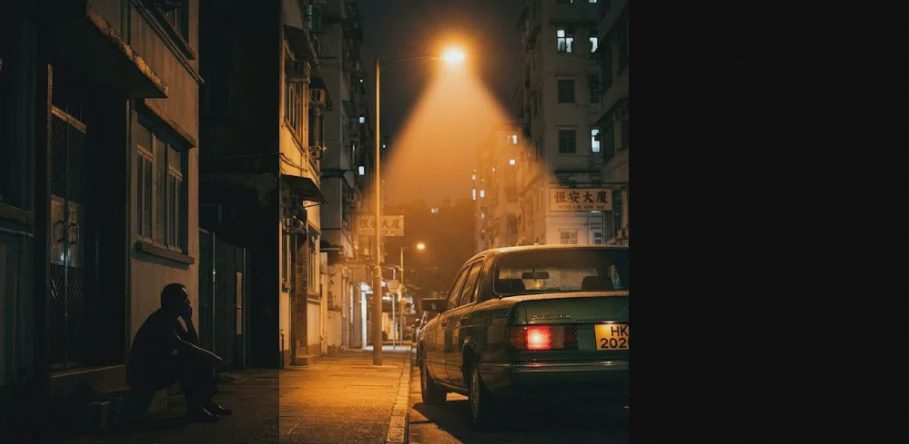
There is a photograph I never took. It exists only in the memory of a drive that ended nowhere, on a street I could not name today, under a streetlight that was probably slated for LED replacement and now exists only as a warm, amber ghost. The car was a dark green sedan. I had parked it at the curb because I had reached that point in a night drive where the destination stopped mattering and the only thing left was the desire to sit still and let the city hum around me. I turned off the engine. I did not open the door. And I watched the streetlight fall across the rear fender in a single, uninterrupted pool of orange that turned the paint into something liquid and deep.
That car was not the fastest I have driven. It was not the most expensive or the most beautiful by any conventional measure. But when I think of it now, it returns to me not as a set of specifications but as that image: a dark shape beneath a sodium glow, a taillight catching the lamp’s reflection like a small, red echo. The streetlight fixed it in my memory. And I have come to believe that many of the cars we truly remember — not the ones we admire, but the ones we carry — are sealed into us this way, not by their performance, but by the light that happened to be falling on them at the moment we realized we would not forget.
How Light Creates Memory
Memory does not distribute itself evenly across a car’s design. It does not record the horsepower curve or the cargo volume. It records moments of heightened perception, and nothing heightens perception like light at the edge of day. Dusk, dawn, the isolated streetlamp — these are the lighting conditions that turn a car from an object into an image. And images, unlike data, endure.
The psychology of this is well-established. Emotional memory is closely tied to sensory specificity. We remember not just what happened, but the color temperature of the light, the texture of the air, the angle at which a shadow fell. A car encountered under these conditions becomes inseparable from the scene. It is no longer a machine. It is the co-occupant of a moment, and the moment gives it meaning.
A car in a dealership lot, under flat fluorescent tubes, is a product. That same car, parked at midnight beneath a single streetlamp on a street you have never walked before, becomes something else entirely. The roofline catches the light along its upper edge. The body color deepens into near-black in the shadows. The glass reflects the lamp as a small, distant sun. Everything that was ordinary about the car’s design is transformed by the economy of the light — because a streetlamp, unlike the sun, is selective. It illuminates only a fragment. And that fragment, by being isolated, becomes eloquent.
Question: How does a single light source like a streetlamp transform the way we perceive and remember a car?
Perception in Daylight or Showroom | Perception Under a Single Streetlight at Night |
|---|---|
The whole car is visible, democratizing attention | Only a portion of the car is lit, creating mystery and focus |
Details are seen in full, often competing for notice | A few details are highlighted — a fender curve, a taillight rim, a window reflection |
The car is judged as an object | The car is experienced as part of a scene |
Memory records the model and color | Memory records the silhouette, the light, and the emotional register |
The Cars That Live in a Cone of Light
I can list the cars that have stayed with me longest, and in nearly every case, the memory is anchored to a specific light source. A silver coupe I drove through a canyon just as the last blue of dusk was fading into black, its flanks catching the final glow of the western sky. A white station wagon parked under a fluorescent garage tube, its paint turned clinical and cool, the interior dome light spilling a warmer yellow across the front seats. A black sports car I saw only once, curbside in a city I was visiting alone, its bodywork reflecting the red neon of a shuttered theater sign like a wound.
These are not cars I owned. Some I drove for only a few hours. One I never drove at all. But they are as vivid to me as cars I have lived with for years, because the light under which I encountered them turned a chance sighting into an image that my brain decided to keep. This is the quiet magic of night driving, and it is one of the reasons I return to it so often. You do not control what the light will do. You can only put yourself in its path and pay attention.
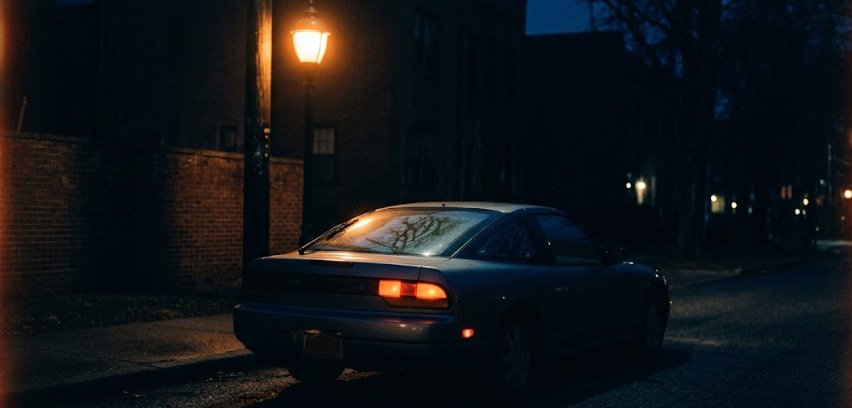
The streetlight is the most democratic of light sources. It is everywhere in the city, unremarkable until it lands on something worth remembering. It does not have the drama of a sunset or the romance of a candle. It is municipal, industrial, functional. But when it finds a car that is parked just so — the front wheel turned slightly, the roofline at the right angle, the bodywork clean enough to hold a reflection — the combination can produce an image as permanent as a photograph. I have tried many times to capture this on 35mm film. Sometimes I succeed. More often, the film records only the light and misses the feeling. The feeling exists only in the moment, and that is part of its value.
The Difference Between Admiration and Memory
There is a distinction I have learned to make over years of writing about cars. Admiration is what you feel for a car that impresses you. Memory is what you carry of a car that moved you. The two do not always overlap. I have admired cars that I can barely recall visually. I can remember cars that I never particularly admired. The difference, I suspect, is that memory requires a scene.
Admiration is often built on abstract qualities: speed, rarity, engineering excellence. These qualities do not need a setting. You can admire a car you have only read about. But memory needs a specific moment — a street, a time of night, a quality of silence, and above all, a source of light that made the car look like nothing else in the world. When those elements align, the car crosses a threshold. It stops being a vehicle and starts being a part of your internal geography.
Why This Matters for How We See Cars
The automotive industry spends billions of dollars trying to make us admire its products. Showrooms are lit to laboratory standards. Press photography is shot at golden hour with multi-flash setups that eliminate every shadow. The goal is to present the car as a perfect, self-contained object, gleaming and unambiguous. But this approach, for all its technical sophistication, misses something fundamental about how human beings form attachments. We do not fall in love with perfection. We fall in love with moments.
A car that has been pressed into memory by a streetlight is not a perfect car. It is a real car, seen in a real place, at a real hour, by a person who happened to be there and happened to be looking. The streetlight does not lie, but it does not tell the whole truth either. It selects. It edits. It shows you just enough to make you want to remember the rest. And in that selective illumination, it gives the car a kind of presence that no brochure can replicate.
This is why I keep driving at night, and why I keep a camera on the passenger seat even when I have no intention of using it. The light is always changing. The cars are always moving. And every so often, a streetlamp finds a machine at exactly the right angle, and the world narrows to a single cone of amber, and something ordinary becomes something indelible. The best cars are remembered in silhouette first — but it is the light that makes the silhouette visible.
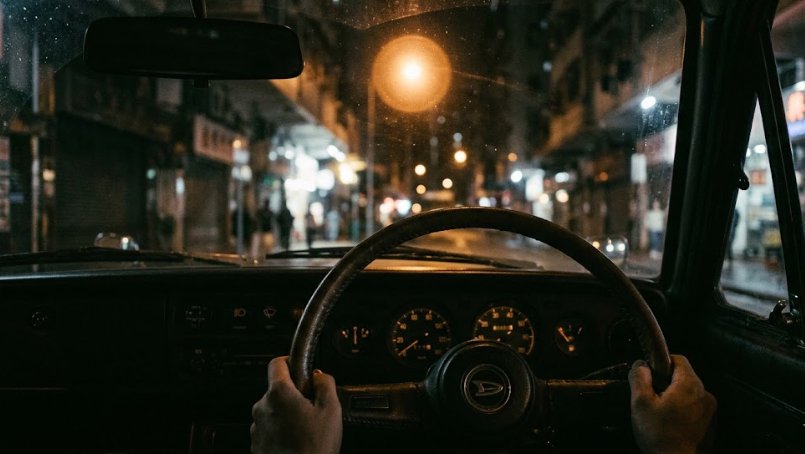
I have written before about what a quiet drive through Los Angeles gives me, and about the parking garage echo as one of the last honest car sounds. This essay is the third in that quiet sequence — an attempt to describe the way cars attach themselves not to our opinions but to our senses. If you have ever remembered a car because of how it looked under a single streetlight, you already know what I mean. If you have not, drive more slowly at night and watch where the light falls. One of these days, it will fall on something that stays.